HomeFree ToolsSectional Chart Decoder
Built for the Oct 27 test format

Read the Chart, Not Just the Figure

Starting October 27, 2026, the Part 107 test embeds chart images instead of pointing you at a printed supplement. Memorizing "Figure 22" won't help anymore — you have to actually read the airspace, airport symbols, and numbers. Tap anything below to learn what it means and whether you need authorization to fly there.

Blue vs. magenta tells you about the tower

Color is the fast read. Tap a symbol to see what it means for your flight.

Blue airport
Has an operating control tower
A blue airport symbol means the field has an operating air traffic control tower (Class B, C, or D airspace). The little tick marks are runways.
Authorization usually required
If the surface airspace around it is controlled (B/C/D), Part 107 ops there need ATC authorization — most easily through LAANC, otherwise FAA DroneZone.
Magenta airport
No operating control tower
A magenta airport symbol means no operating control tower at that field. It often sits in Class E or Class G airspace.
Check the surrounding airspace
No tower doesn't automatically mean "no authorization." If the airport sits inside a dashed magenta Class E surface area, you still need authorization. If it's in plain Class G, you don't — but you still follow all Part 107 rules.
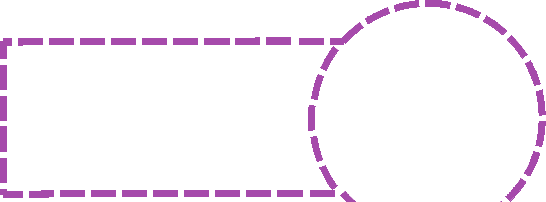
Dashed magenta ring
Class E airspace to the surface
A dashed magenta circle is Class E airspace that starts at the surface, usually drawn around a non-towered airport that has instrument approaches. It is controlled airspace all the way down to the ground.
Authorization required
This is the classic trap: no tower, but still controlled to the surface. Part 107 ops here require ATC authorization. This is exactly the kind of question the chart-reading section loves.

Faded magenta vignette
Class E starting at 700 ft AGL
A soft, faded magenta shading (darker on the outside edge) marks Class E airspace that begins at 700 ft AGL — not at the surface.
No authorization needed below it
Because the controlled airspace doesn't start until 700 ft AGL, a normal Part 107 flight below 400 ft AGL is in Class G underneath — no ATC authorization required. (A faded blue vignette is the same idea but for Class E starting at 1,200 ft AGL.)
💡
Quick rule: solid blue or magenta lines = airspace boundaries you read for floors/ceilings. Faded shading = where Class E begins above the ground. A dashed magenta ring is the one that catches people — controlled to the surface even with no tower.

Each class, and whether Part 107 needs a green light

Tap a class for how it's drawn, the numbers you'll see, and the authorization answer.

B
Class B
Solid blue lines · busiest airports
Drawn with solid blue lines in an upside-down wedding-cake of shelves around the busiest airports. Numbers like 100/SFC read as ceiling 10,000 ft MSL down to the surface.
Authorization required
LAANC is available at many Class B fields. No coverage there? Request through FAA DroneZone.
C
Class C
Solid magenta lines
Solid magenta lines, typically two rings around a moderately busy towered airport. Shelf numbers like 41/SFC = 4,100 ft MSL down to surface on the inner ring.
Authorization required
Get it via LAANC where available, otherwise DroneZone.
D
Class D
Dashed blue line
A dashed blue ring around a smaller towered airport. The blue boxed number (e.g. [25]) is the ceiling in hundreds of feet MSL — 2,500 ft MSL — down to the surface.
Authorization required
LAANC covers many Class D fields. The tower is only "operating" during published hours; outside them it may revert to Class E or G — but plan as if authorization is needed.
E
Class E
Magenta — surface or 700 ft AGL
Class E is controlled airspace that isn't B/C/D. Dashed magenta = starts at the surface (authorization required). Faded magenta = starts at 700 ft AGL. Faded blue = starts at 1,200 ft AGL.
Depends how it's drawn
Surface (dashed) Class E needs authorization. Class E that begins at 700/1,200 ft AGL leaves Class G underneath — no authorization for a sub-400 ft flight.
G
Class G
Uncontrolled — no boundary line
Class G is uncontrolled airspace. It has no special boundary line — it's simply what's there beneath the Class E floor (often up to 700 or 1,200 ft AGL, sometimes higher).
No authorization required
No ATC authorization needed — but every other Part 107 rule still applies: 400 ft AGL max, visual line of sight, see-and-avoid, weather minimums, and Remote ID.

What the numbers on the chart actually mean

Floors, ceilings, tower heights, and frequencies — decoded.

100
SFC

Airspace shelf, ceiling over floor. Top number 100 = 10,000 ft MSL ceiling (in hundreds of feet). SFC = floor is the surface. So this shelf runs surface up to 10,000 MSL.

100
40

Floor that isn't the surface. 100 = 10,000 MSL ceiling, 40 = 4,000 MSL floor. The controlled shelf sits between 4,000 and 10,000 MSL — Class G is below 4,000.

[ 25 ]

Class D ceiling. A blue boxed number is the Class D top in hundreds of feet MSL — here 2,500 ft MSL — down to the surface.

1289
(287)

Obstruction height. Top = height above sea level (1,289 ft MSL). Bottom in parentheses = height above ground (287 ft AGL). Towers, antennas, and buildings use this.

CT - 118.3
Ⓒ 122.95

Frequencies. CT = control tower frequency. The magenta marks the CTAF (Common Traffic Advisory Frequency) used at non-towered fields for self-announcing.

25 *L 72

Airport data line. Field elevation (25 ft), *L = lighting available (the * means see the Chart Supplement), and longest runway in hundreds of feet (72 = 7,200 ft).

⚠️
MSL vs. AGL is the #1 trap. Airspace floors and ceilings are in MSL (above sea level). Your 400 ft Part 107 limit is AGL (above the ground below you). Obstruction tops are given both ways — read which one the question wants.

Five quick chart-reading questions

No supplement to flip to — just like the new format. Read it and answer.

Question 1 of 5Score: 0

Not sure if you need authorization?

Reading the chart tells you the airspace. The LAANC Required? tool walks the decision step by step — and kills the "5-mile rule" myth for good.

Chart reading is now half the battle.

The full app has an Embedded Chart Practice mode built for the Oct 27 format — read real chart crops and answer, no supplement to lean on. One-time $39.99.